
DesignLine Roommate MHP10 and MHP11 are Illegal and Non-Compliant
Failure to be listed in the NRCan Searchable Product List and the DOE Compliance Certification Management System (CCMS) Database.
In Canada and the USA, all air-conditioning and heat-pump systems must be listed in the NRCan/DOE CCMS databases. In fact, it is illegal to import or sell a unit that is not listed. At the time of this publication, March 16, 2026, the Roommate MHP10 and MHP11 are not listed in the NRCan Searchable Product List or in the DOE Compliance Certification Management System (CCMS) Database.
Failure to meet NRCan or DOE Minimum Efficiency Requirements
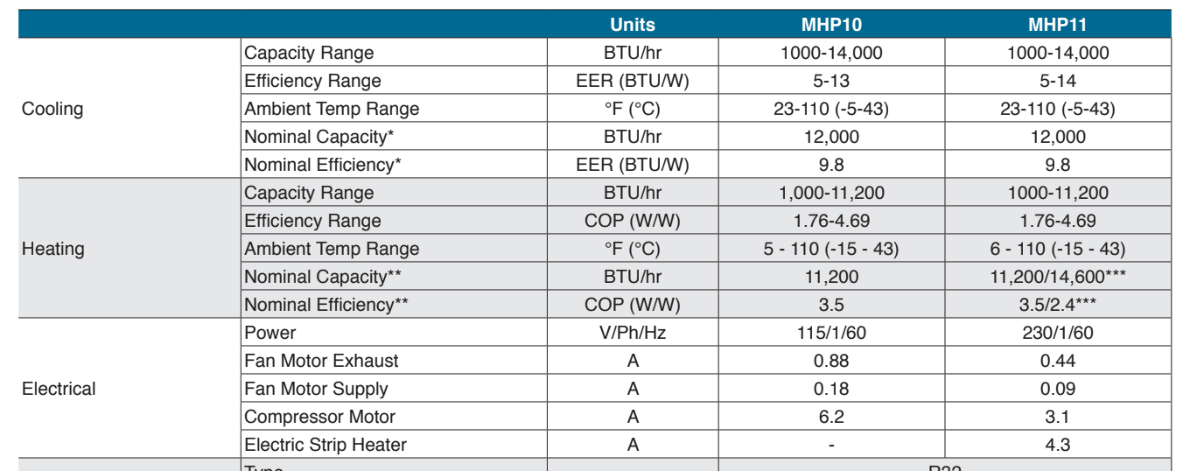
DesignLine Roommate MHP10 and MHP11 both have a nominal cooling capacity of 12,000 BTU. Under federal law, any 12,000-BTU heat pump in this class must meet a minimum of 13.4 SEER2 in the USA and Canada, or 9.3 CEER in Canada only, to be legally sold, installed, or used. DesignLine does not publish a SEER2 or CEER value because the unit cannot meet the required numbers when tested in a certified lab. This alone renders the units illegal.
Illegal Rating
DesignLine uses the wrong rating metric: EER instead of SEER2 or CEER (Canada only). DesignLine publishes only an EER for cooling and a COP for heating. Neither EER nor COP is a legal rating for this product category. For a heat pump, federal law requires SEER2 and HSPF2 or CEER (Canada only). DesignLine deliberately avoids publishing the correct data because the unit would fail. This alone renders the units illegal.
Illegal Misclassification
By using an EER instead of SEER2 or CEER (Canada only), DesignLine is classifying MHP10 and MHP11 as PTHP, but they do not meet the PTHP definition under the Energy Efficiency Regulations. A lawful PTHP must have a wall sleeve, a separate unencased chassis, and through-the-wall mounting. DesignLine’s MHP10 and MHP11 units lack these traits. Misclassifying the MHP10 and MHP11 as PTHP by using EER is a direct violation of NRCan and DOE rules and is illegal.
Miscalculated Performance Numbers
The heating capacity is fraudulently listed as 11,200 with a 3.5 COP, whereas the manufacturer, Nordica, which also inflates its numbers, publishes only 9,000 BTU at 3.1 and 3.4 COP. Moreover, when calculating Nordica's numbers, the COPs are 2.84 and 3.10. So, somehow, MHP10 and MHP11 are claimed to have both higher capacity and higher COP at a higher load. Impossible.
Fraudulent and Fake Numbers
The 12,000-BTU capacity they claim, along with the 9.8 EER rating, is fraudulent. When tested in a lab, this unit will not produce 12,000 Btu/h and an EER of 9.8. So, even ignoring the misclassification and wrong ratings, the actual numbers they claim are fake.
Regulatory Violation Summary: DesignLine’s MHP10 and MHP11
These products are illegal to distribute, specify, install, or use in the United States and Canada. DesignLine's published efficiency numbers are fabricated, physically impossible, and use illegal EER rating metrics instead of the legally required SEER2 or CEER metrics that have not been legally acceptable since January 1, 2023. The MHP10 and MHP11 fail to meet DOE and NRCan minimum efficiency requirements under every applicable classification.
Minimum Efficiency Requirements Not Met | ||||
|---|---|---|---|---|
Classification | Metric | Legal Minimum Required | DesignLine's Status | Result |
Heat Pump (cooling) | SEER2 | ≥ 13.4 | Publishes an illegal EER metric with fabricated data | ❌ Fails |
Heat Pump (10,000 BTU heating / US) | HSPF2 | ≥ 6.7 | Numbers fabricated — no valid rating exists | ❌ Fails |
Heat Pump / Room Air Conditioner (Canada) | CEER | NRCan minimum | Publishes illegal EER metric — not listed on NRCan database | ❌ Fails |
These ratings cannot simply be invented. They must be established through testing in a genuine laboratory under correct DOE and NRCan test procedures. DesignLine has not done this, and the data it publishes makes clear why.
Illegal Rating Metrics Uses | ||
|---|---|---|
Required Metric | Metric DesignLine Publishes Instead | Legal Status |
SEER2 or CEER | EER | ❌ Illegal — EER is not an acceptable substitute for SEER2 or CEER under any applicable standard and has not been legally acceptable since January 1, 2023 |
Publishing a retired and inapplicable metric is not a technicality or an oversight. EER was replaced by mandatory legal requirements in 2023. Its continued use constitutes a deliberate misrepresentation of compliance status to customers, dealers, and regulators.
Faking Test Results | ||
|---|---|---|
Violation | US Law Violated | Canadian Law Violated |
DesignLine fabricated MHP10 and MHP11 laboratory test data rather than conducting legitimate testing under the required industry methods, AHRI 210/240 and ASHRAE 37 | 10 CFR Part 429 | Energy Efficiency Act; Energy Efficiency Regulations, 2016 |
Published cooling and heating efficiency numbers are fabricated, physically impossible, and contradict basic mathematics | 10 CFR Part 430 | Energy Efficiency Regulations, 2016 |
DesignLine derived published performance ratings from non-compliant test conditions and failed to use the correct AHRI 210/240 and ASHRAE 37 test methods, rendering every efficiency rating ever published legally invalid | 10 CFR Part 429/430 | Energy Efficiency Regulations, 2016 |
Breaking Consumer Protection and Competition Laws | ||
|---|---|---|
Violation | US Law Violated | Canadian Law Violated |
False efficiency claims and misleading energy performance advertising constitute deceptive trade practices, exposing DesignLine to regulatory action and civil lawsuits from competitors, including claims for damages | FTC Act Section 5, 15 U.S.C. § 45; Lanham Act, 15 U.S.C. § 1125(a) | Competition Act, R.S.C. 1985, c. C-34 |
Maximum penalties for serious violations or refusal to take corrective action | FTC civil penalties up to $53,088 per violation | Energy Efficiency Act fines $10,000–$200,000 |
Selling Products That Should Not Be on the Market | ||
|---|---|---|
Violation | US Law Violated | Canadian Law Violated |
MHP10 and MHP11 do not meet minimum efficiency standards, exposing every distributor and dealer carrying the products to joint legal liability | 10 CFR Part 430 | MEPS under Energy Efficiency Regulations, 2016 |
MHP10 and MHP11 fail the mandatory minimum efficiency thresholds because published numbers are falsified | SEER2 under 10 CFR Part 430 | CEER under Energy Efficiency Regulations, 2016 |
DesignLine uses illegal EER rating metrics instead of the legally required metric, which has been mandatory since January 1, 2023 | SEER2 under 10 CFR Part 430 | CEER under Energy Efficiency Regulations, 2016 |
DesignLine never registered products with regulators or filed required certification reports before distribution | DOE CCMS — fines up to $575/model/day under 10 C.F.R. § 429.120 | NRCan Searchable Product Database |
MHP10 and MHP11 units were never certified by an accredited certification body and do not carry the mandatory compliance mark | DOE Certification under 10 CFR Part 429 | Standards Council of Canada Energy Efficiency Verification Mark |
DesignLine violated product classification rules by misclassifying the MHP10 and MHP11, affecting which efficiency standards and test procedures apply | DOE Product Classification Rules under 10 CFR Part 430 | NRCan Product Classification Rules under Energy Efficiency Regulations, 2016 |
Lying to Customers and Regulators | ||
|---|---|---|
Violation | US Law Violated | Canadian Law Violated |
MHP10 and MHP11 efficiency and capacity ratings directly conflict with what government-certified testing would produce, and false information was filed with regulators | 10 CFR Part 429.12; 18 U.S.C. § 1001 — federal criminal offence | Energy Efficiency Act — fines up to $10,000 per violation |
Nameplates, product literature, and marketing materials display unsupported efficiency ratings using illegal rating metrics | FTC Energy Labeling Rule, 16 CFR Part 305; DOE Labeling Requirements under 10 CFR Part 430 | NRCan EnerGuide Labeling Requirements under Energy Efficiency Regulations, 2016 |
DesignLine misrepresented MHP10 and MHP11 certification and compliance status to customers, dealers, regulators, and certification bodies | 18 U.S.C. § 1001 — federal criminal offense | Energy Efficiency Act of 1992 |